
KENNESAW, GA — The Partnership for Innovation recently held its Emerging Innovators Celebration to honor the largest class of PIN Summer Interns and their projects; and the 2024 and 2025 PIN Fellows. These students, recent graduates, and mid-career professionals work on projects that impact kids’ health, address food insecurity, bridge the digital literacy gap, bring artificial intelligence (AI) to manufacturing, and more.
Kennesaw State University (KSU) hosted the event and President Kathy “Kat” Schwaig, welcomed the more than 200 project team leaders, government officials, business and nonprofit leaders, educators, interns, fellows, and family members to the event. City of Kennesaw Mayor Derek Easterling, Cobb County Commission Chair Lisa Cupid, PIN Board Member and Commissioner of the Georgia Department of Community Affairs Christopher Nunn also welcomed attendees.
PIN Fellowship
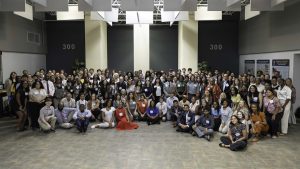
PIN Fellows are primarily early career professionals who work for six months each in the public and private sectors of one industry to help drive innovation and promote economic mobility. The 2025 cohort is comprised of 12 Fellows working in areas including AI for banking and manufacturing, clean energy policy, workforce, sustainability, and transportation.
Yvette McCauley is a PIN Fellow working her first six months at The Spires at Berry College, a senior community (for older adults not seniors in college), in Rome, Georgia. For this work she is paired with Fellow Shirley Berry Miles. The two, who are not new to their careers, but have years of working in education and with older adults, will assess, design, and implement tailored programming to help people at The Spires become more digitally literate. The project, Fostering Digital Literacy Through Intergenerational Innovation, is funded by the AT&T Foundation.
“Digital literacy today is necessary for people of all ages, specifically our seniors,” McCauley said. “They have to shop [online] nowadays, have to complete medical paperwork, everything. So it’s necessary to provide this service. In the process, we’re also learning what the needs are for this type of community.”
McCauley and Miles are the first PIN Fellows to become part of the program later in their careers.
“This Fellowship cohort in particular is very interesting and special, because for most of the years that we’ve operated, the Fellowships have been open to those who have recently graduated from college and have at least a bachelor’s degree,” said Clarence Anthony Jr., PIN’s workforce development manager. “For this cohort, you see a representation of people from a number of different generations, a wide age gap, as well as broader and wider education levels.”
PIN Summer Interns
This year saw a record number of PIN Summer Interns participate in the program. Out of almost 700 applications (another record), the program accepted 103 interns who worked on 51 projects in 27 communities around Georgia and in Alabama, Virginia, and Texas.
“We are the largest program of our kind,” said Cody Cocchi, PIN’s student engagement manager. “One of the parts I love about this program is that we’re able to bring so many dynamic people together to build these projects.”
Summer 2025 saw interns tackling real-world challenges ranging from AI applications to Native American initiatives.
Intern Bronwyn Armitage worked with the Lower Muskogee Creek Tribe in Whigham, Georgia, on an aquaponics project. Aquaponics combines aquaculture — raising aquatic animals, in this case bluegill — with hydroponics, which means growing plants without soil. Armitage, a third-year Georgia Tech environmental engineering major, manages Tech’s community garden. She was enthusiastic about the work she did with the tribe, which was to help them set up sensors to test water quality and provide security.
“It was a really wonderful experience,” Armitage said. “I started the beginnings of an IoT [internet of things] setup where they now have a sensor that can detect water level and send word to their phone, and that’s just the first of many sensors they could deploy. They also now have a better understanding of what they should do to care for their aquaponic system.”
KSU has been home to an ongoing PIN-sponsored effort and supported by PIN interns for the last two years. The 911 Mental Health Crisis Response Detection and Redirection is a project to develop software that helps first responders identify when a 911 caller is having a mental health crisis and get them the appropriate care.
At the Emerging Innovators event, Brittany Collins, executive director of the Betty and Davis Fitzgerald Foundation, an organization that supports equitable access to quality education and mental health support, announced that organization’s support — $50,000 over two years — for the 911 project.
“Nearly 150 of Georgia’s counties, out of 159, have mental health workforce shortages,” she said. “We also know that emergency room visits for behavioral and mental health crises have doubled since 2015, across our region. Solving this crisis requires strategic philanthropic investments, strengthening the mental health workforce, driving systemic change, and championing coordinated cross-sector collaboration. It requires philanthropy, government, public systems, educational institutions like KSU, and community-based organizations, all working together.”
The event also featured a panel discussion on Investing in Talent: The Engine of Innovation. Moderated by Rick Clark, executive director of strategic student access at Georgia Tech, the panelists included Ashley Peterson, vice president of people solutions at Cox Enterprises; Charles Jackson, innovation development manager, Alabama Power; and Taylor Pratt, senior director of career supports at Achieve Atlanta. Georgia Rep. Scott Holcomb (District 101) also spoke.
Highlights of the event were lightning presentations by interns and fellows about their projects, and project poster presentations, where interns and fellows were available to answer questions about their projects. This year, for the first time, the event included a poster contest. The winners were:
- PIN Interns Ashley Beaty and Jeongbin Son, Coding for cultivation;
- PIN Interns Thomas Brown and Caitlin Kimpe, Smart tech solution to solve homelessness;
- PIN Interns Haris Tsiotras and Iliyan Kajani, Fostering Smart and Sustainable Travel;
- PIN Fellow Basmah Ismail; and
- PIN Fellow Reagan Cook.
The excitement of the event and importance of PIN’s work around the state were summed up by Elisabet Ortiz, a PIN Intern in 2024 and 2025. “Right now, Georgia and the South uniquely are experiencing so much growth that we’re not seeing in other parts of the country, and that is a huge opportunity,” she said. “Now is the time to really invest in innovators, to invest in organizations that are doing amazing initiatives that are giving back to the community and growing the economy. That that doesn’t happen without having formal and financial support for those organizations and individuals to be able to have a workforce and to be able to actually have an investment in the work that they’re doing. PIN actually gets it done.”