
ATLANTA — Georgia Tech’s Enterprise Innovation Institute (EI2) recently hosted the U.S. Economic Development Administration’s (EDA) Regional Director Sheba Person-Whitley, who visited the group’s leadership team to learn about the unit’s work and impact across the state.
Person-Whitley, who assumed the post in December of 2024, is based in the EDA Atlanta Regional Office, which serves not only Georgia but also Alabama, Florida, Kentucky, Mississippi, North Carolina, South Carolina, and Tennessee. She was joined on her August 18 visit by EDA Georgia/Kentucky Economic Development Representative Jonathan Corso.
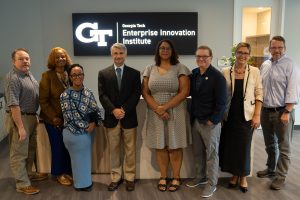
Members of the EI2 leadership team detailed the group’s multifaceted range of programs while highlighting their respective histories and ongoing connections to the EDA.
EI2 Vice President David Bridges laid out the overall focus of the organization. “We are capacity builders. We help communities to co-create solutions for the specific limiting factors that prevent the growth of their local economies,” he said. “EI2 has a unique approach, in that we are driven by a community-first view.”
EI2, which serves as Georgia Tech’s chief economic development unit, was founded in 1960, five years before the establishment of the EDA. Since then, the two groups have had a longstanding relationship: EI2 was one of the first EDA University Center awardees and has maintained that status since its inception.
Bridges and his colleagues showcased past and present EDA initiatives administered by EI2 programs. Notable among these is the Georgia Tech EDA University Center, which is overseen by Enterprise Innovation Institute Global (EI2 Global) and has completed 54 projects in the EDA Atlanta region and Puerto Rico since 2017.
Additionally, with the support of EDA, Georgia Artificial Intelligence in Manufacturing (Georgia AIM) has been serving residents, manufacturers, and educators across Georgia through 15 different programs that, among other things, transform manufacturing for a new generation.
Person-Whitley shared some observations about regional economic development, noting that the flow of people, goods, and services are not bound by state lines. Rather, states interact with one another as both competitors and collaborators.
“I call it ‘co-opetition,’” she said, posing a challenge for regions to “think about collaboration in a different way, versus the historic way, in which economic development was very, very competitive.”
A fluid, collaborative approach to development is second nature to EI2 and dovetails with the goals of a number of its programs where the scope of work is regional, including the Center for Economic Development Research, the Southeastern Trade Adjustment Assistance Center (SETAAC), Georgia Tech’s Industrial Assessment Center, and the Partnership for Innovation (PIN).
Person-Whitley cited disaster funding and rebuilding as being top of the list of priorities for the EDA Atlanta Regional Office. To that end, EI2’s Safety, Health, and Environmental Services program offers OSHA documents providing safety guidance for dealing with natural disasters, including hurricanes. Other EI2 programs that address the disaster focus include EI2 Global through its FEMA preparedness programs, which includes some training in partnership with the Georgia Manufacturing Extension Partnership (GaMEP).
Widening the lens beyond state — and even national — borders is EI2 Global, which currently collaborates with eight countries and since 2012 has worked with 30. Through the Colombia-based Medellín Innovation and Entrepreneurship Center, Georgia Tech is able to help a significant trade partner build ecosystems and bolster their local economies, as well as bring firms to the United States through the Soft Landing program, which is anchored in various countries around the world.
“We convene a lot of parties under one roof, in one unit which makes us unique. We recognize that uniqueness and bring everyone together to solve problems, rather than being siloed,” said Bridges.
“We have been very strategic to ensure that we’re serving all the communities across Georgia. That’s why the Advanced Technology Development Center (ATDC) has many startup catalysts around the state. That’s why the Georgia Manufacturing Extension Partnership has regional managers. That’s why Georgia AIM is working with communities all over the state. There’s a lot of attention and support for rural Georgia, because we know that the overall health of the economy can’t just rely on Atlanta and the state’s other major cities.”
Person-Whitley recently moved to the EDA Atlanta Regional Office after heading up the EDA Seattle Regional Office since December 2021. Prior to that, she worked as an economic developer in California, Louisiana, and North Carolina, where she was raised.
Relocating from one coast to another, said Person-Whitley, highlighted some of the qualities that make people different — but it also underscored the larger values they share. “Economic development is not one-size-fits-all,” she explained. “Yet, at the same time, most people want the same types of things: to be able to afford to live where they want to be, to have access to good housing options, to have great education and safer environments, and to feel like they are winning in life.”
She summed up the EDA’s commitment to the populations they serve, regardless of region: “We’ve added a lot of programs, and there is something for everyone. We prioritize having the right tools in the toolkit to meet the moment, so every community has the opportunity to tailor an approach to what is important to them.”